Looking back at my previous projects, the summary of topics has been the most helpful way for me to locate my position. My practice repeatedly returns to issues of seeing and representation, recomposition, and meaning generation, and I often use systematic archives as a way to argue, test, and explore. My key terms are therefore cross-media, (de/re)construction, and new narrative. I eventually selected one corner from one of the outcomes of my Methods of Iterating project as the snippet, because it was sufficiently abstract. The original project aimed to explore whether systems of viewing are neutral, and generated a large number of viewpoint images in order to challenge the authority of the image. This was worth developing further because the original outcomes were too abstract and too numerous, without a clear point of grounding, although the underlying logic was strong.
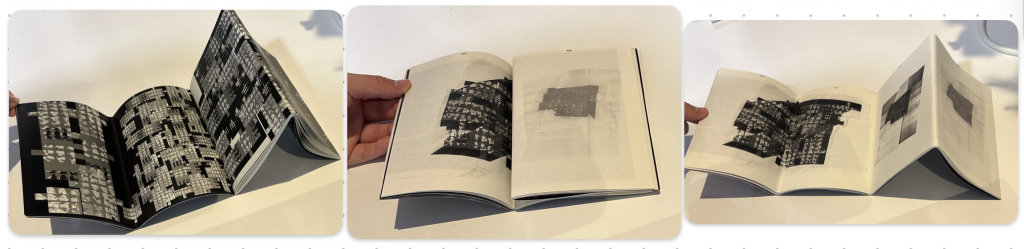
The iterations began digitally and then expanded into physical intervention. Both stages were used to explore how meaning can be reorganised through structured reconfiguration; how perception is shaped by systems of viewing; and how basic units generate new relations and narratives through repetition. The digital interventions included cut and stretch, classified repetition, graphic extraction, and degeneration. I then selected three stage outcomes and brought them into the physical world through folding, cutting, reassembling, and interaction with the scanner. Through repeated intervention and rescanning, I developed a process of iteration. The binding of my 100-page publication was inspired by newspapers and Real Review magazine: it functioned not only as a collector, but also as a structure that created accidental encounters through binding and folding. I realised that meaning is not stable, but depends on how it is organised, and can also be generated through invisibility. The image also gradually degraded and became worn through intervention, and this process revealed new relations.
However, I received feedback that the iteration needed to become more systematic and should involve appropriate parameters. At that stage, it felt too intuitive and risked appearing as if theoretical terms were being applied retrospectively. It was also somewhat chaotic. The enquiry needed to be narrowed down and clarified. The question of how viewing becomes an act of unfolding had exploratory value as an open-ended question, rather than continuing to focus on degradation or deconstruction.
Leave a Reply