- Theory (Form & Frame)
Richter, D. (2014) ‘Revisiting Display: Display and Backstage’, OnCurating, Issue 22: Politics of Display. Available at: https://www.on-curating.org/issue-22-43/revisiting-display-display-and-backstage.html (Accessed: 30 April 2026).
Richter inspired my fold/unfold work as an explicit curatorial theoretical anchor. She distinguishes between display (the surface that is presented) and backstage (the parts of the exhibition apparatus that are deliberately concealed yet sustain the whole operation), arguing that “the horizon of meaning [of display] indicates the primacy of the surface over a complicated, difficult, and incomprehensible background” (Richter, 2014). Drawing on Staniszewski’s history of MoMA, she further observes that, of all imaginable presentation modes, “precisely those emerged as ritualised forms that made one forget their ideological character, thus preventing viewers from recognising their own voyeuristic perspective” (Richter, 2014). The more successful the display, the more invisible its frame. This observation precisely names what my fold/unfold operations attempt to reverse: fold is not a way of removing the frame, but a way of making the frame surface and be felt by the reader. The moment Richter describes in Darren Almond’s Live Sentence (2004), where “the projection looks back at the viewers” (Richter, 2014), offers me a specific reference point — unfold can be understood as an event of reversed sightline, where the reader, while making a small action, becomes aware of having been organised by a structure all along. In this sense, the display/backstage pair initially provided the opportunity to enter the curatorial apparatus and ask what an exhibition guidebook conceals in order to function as a display.
[Revision & Rewrite]
Drucker, J. (2014) ‘Designing Graphic Interpretation’, in Graphesis: Visual Forms of Knowledge Production. Cambridge, MA: Harvard University Press, pp. 180–192.
Drucker contends that interpretation is not only produced by content but also through the spatial organisation of pages, sequences, and graphic relations, which is known as the “cognitive armature” (Drucker, 2014, p.180). Notably, her initial examples—a museum exhibition and a walk through a foreign city—are both conceptualised as graphic interpretive systems, where “the museum rearranges walls, narratives, and frameworks of interpretation in new visual, spatial acts” (Drucker, 2014, p.181). At the PTI (Position through Iterating) stage, this perspective prompted me to consider form itself as an interpretive structure. In this context, the previously overlooked museum example becomes directly relevant. Drucker positions exhibition viewing and graphic reading as parallel acts of spatial interpretation, which provides a theoretical grounding to treat a guidebook as a cognitive armature rather than merely a reading aid. Her advocacy for non-linear, “polyvocal” composition (Drucker, 2014, pp.187–188) further supports a modular approach instead of a single prescribed sequence. Interpretation, therefore, can be distributed across multiple pathways through the same material, with the reader’s navigation actively contributing to the construction of meaning.
Friedberg, A. (2006) ‘The Frame’, in The Virtual Window: From Alberti to Microsoft. Cambridge, MA: MIT Press, pp. 60–98.
Friedberg argues that the frame does not merely contain an image but instead determines visibility through exclusion, specifying what remains within and what is omitted (Friedberg, 2006, p.80). The act of seeing inherently involves not-seeing. She traces the concept of the frame across the window, camera obscura, photograph, and cinema, demonstrating that each iteration constructs a distinct position for the viewer. Notably, the moving and multi-frame image disrupts any singular and fixed viewpoint (Friedberg, 2006, pp.83–85). Previously, it helped me to reposition the framing from a neutral border to an active constructed method. At the PTC stage, the argument expands to the exhibition, which can function as a frame including certain works while excluding others. A guidebook serves as an additional frame, determining which images and encountered sequences are represented. Thus, designing the guidebook becomes a practice in exclusion arrangement rather than only presentation. Similar to Richter, who locates the frame in the curatorial apparatus, Friedberg insists the frame is already operative at the level of every single image. This means a guidebook is not only framed by curatorial decisions but also as a framing operation on every page. More significantly, Friedberg’s analysis dissolves my previous distinction between curatorial and graphic decisions, revealing both as acts of framing. This perspective allows my enquiry to approach publication design as a curatorial operation, rather than as a service that follows curatorial choices.
Carrión, U. (1985) ‘The New Art of Making Books’, in Lyons, J. (ed.) Artists’ Books: A Critical Anthology and Sourcebook. Rochester, NY: Visual Studies Workshop Press, pp. 121–125.
Carrión’s claim that “a book is a sequence of spaces” (Carrión, 1985, p.121) reframes publication as a space-time structure rather than merely a container for content. A book functions not as a passive holder of text but as a system that organises access, perception, and movement. This perspective previously informed my choice to use publication as a primary mode of presentation, treating folding and unfolding as integral to generating meaning. On the other hand, it inspires me that if a book constitutes a sequence of spaces, a guidebook designed for an exhibition can respond to another sequence of spaces: the gallery itself, which is both interdependent. This perspective reframes the relationship between exhibition and publication as a continuous spatial system rather than a supplement. Reading a guidebook is a distinct form of visiting exhibition, governed by the same spatial logic Carrión identified in the book as medium, such as pacing, adjacency, withheld view, and the temporal experience of page-turning.
- Practice (Fold Operations)
Halley, P. (2002) ‘Peter Halley in conversation with Wolfgang Tillmans’, in Verwoert, J., Halley, P. and Matsui, M. Wolfgang Tillmans. London: Phaidon Press.
Garand, J.-S. (2025) ‘Wolfgang Tillmans: Nothing could have prepared us—Everything could have prepared us’, The Brooklyn Rail, October. Available at: https://brooklynrail.org/2025/10/special-report/wolfgang-tillmans-nothing-could-have-prepared-us-everything-could-have-prepared-us/ (Accessed: 30 April 2026).
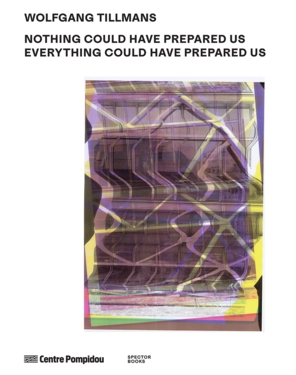
Tillmans, W. (2025) Nothing Could Have Prepared Us – Everything Could Have Prepared Us. Edited by F. Ebner and O. Frydryszak-Rétat. Leipzig: Spector Books.
Tillmans’s curatorial method extends the fold/unfold enquiry from the page to the contextual scale of the wall and the room. He describes his hanging practice as “multi-vectored”: photographs of radically different sizes are carefully positioned to point “against each other”, ensuring that each image keeps its own voice rather than being subsumed into a single visual hierarchy (Halley, 2002). What appears to be a loose dispersion is actually a calibrated system. Within this system, adjacency, shifts in scale, and the height of each print collectively construct a larger spatial narrative that the viewer can physically experience. Decoding the image is no longer immediate; instead, it requires the viewer to slide and layer within it, forcing the eye to focus and refocus as it navigates between the minute and the monumental (Garland, 2025). This approach reconstructs folding, initially as a material experiment with spatial vectors, in order to explore the sequence and movement of viewing, as well as the directional decisions that only emerge when the viewer turns, tilts, or moves closer. As a result, the wall becomes a visible structure that gradually comes into view, rather than a neutral support.
This logic is reversed in the form of the book. The title Nothing Could Have Prepared Us — Everything Could Have Prepared Us (Tillmans, 2025) itself presents a paradoxical unfolding: a negation followed by an affirmation, requiring the reader to hold both positions open at the same time rather than resolve them. In its exhibition panels, work boards and installation shots appear alternately, functioning less as a catalogue than as a paper-based installation. Together, the wall and the book suggest that folding can be understood as any decision that distributes visibility across a surface, sequence, or space. Collectively, they address bodily participation and perception, designing conditions that guide the act of viewing.
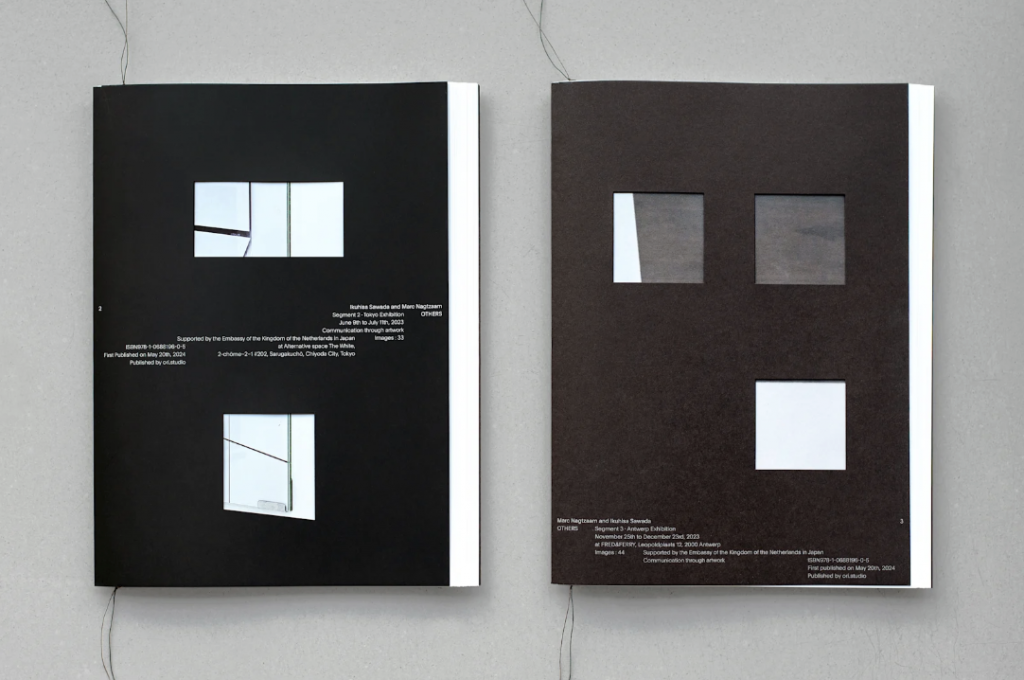
Cormier, M. and Fan, X. (2024) OTHERS: Segment 2 – Process 1. Beijing: ori.studio.
The OTHERS series documents a long-distance collaboration between two artists whose trajectories run as parallel paths reaching toward ends, “simultaneously shared and separate” (ori.studio, 2024). This reference contributes to my contextualising enquiry that, rather than represent, the publication as a material structure can stage an encounter. The book uses cross-spread folding to create frames of different sizes, so that turning a page also rescales the field of view. Images of the two artists’ work are positioned on either side of a fold or across a spread, generating juxtapositions, unexpected encounters, and quiet dialogues. Instead of reproducing a fixed relationship, the publication produces connections through arrangement. This approach influenced my understanding of a guidebook as more than a vessel. The book can vary the scale of its frame from spread to spread, and folding can stage encounters between separately existing objects. Therefore, a guidebook can also be known as a way of translating an exhibition into the paper medium, not by copying its images but by reorganising how its elements interact. This reference led me to consider folding as a structure that produces adjacency, rather than merely recording it.
Barbican Centre (2025) Encounters: Giacometti × Mona Hatoum [Exhibition]. London: Barbican Art Gallery, 3 September 2025 – 11 January 2026.
Encounters: Giacometti × Mona Hatoum is the second exhibition in a series that stages dialogues between Alberto Giacometti and contemporary artists. Curated under the subtitle Divide, the exhibition brings together two artists separated by nearly a century to explore shared themes of domestic and hostile environments, as well as the impact of these spaces on the viewer (Barbican Centre, 2025). For my contextual enquiry, this exhibition offers a curatorial example of fold and unfold at the scale of a room. Inside the exhibition space, the resulting pairings function as cross-temporal echoes rather than as a chronology. A particularly notable gesture is the integration of Giacometti’s The Nose (1947) into Hatoum’s Cube (2006), so that a historical sculpture is folded into a contemporary one and the two artists inhabit a single object. Throughout the gallery, the same motifs reappear in altered scales: a small bronze figure is juxtaposed with a room-sized cage, and domestic objects become hostile through repetition. The exhibition also transforms sculpture into image through press releases, gallery icons, and printed materials, allowing three-dimensional works to circulate as two-dimensional signs within the exhibition itself. As my main studio response, this exhibition provided a practical example of how fold and unfold can function as curatorial operations to compress, juxtapose, and re-scale objects, shifting the focus from the objects themselves to the relationships between them as the primary site of meaning.
[Revision & Rewrite]
UCCA Center for Contemporary Art (2025) 廖斐:如人有目. Available at: https://ucca.org.cn/exhibition/liao-fei/ (Accessed: 24 April 2026).
Liao Fei’s paper-based works treat folding as a mode of formal enactment, rather than as an expressive gesture. In the development of his Partially Blurred Circles series (2024–2025), folded and connected paper forms gradually derive from one another, producing a spatial contradiction between curves and straight lines, and extending the work from material intervention towards an investigation of geometric and logical relations (UCCA, 2025).
Previously, this tendency supported a more systematic approach to media experimentation. What remains most instructive is the idea of folding as a methodological discipline: a way of completing logical movements within a larger material system. This has continued to influence the perspective of my own practice. Folding and unfolding are not only methods, but also objects of research.
The variations follow a coherent set of rules and can therefore be systematically compared. The rhythm created through repetition, together with the process of unfolding, shapes both perceptual layers and informational hierarchy. His work led me back to exploring the narrativity of the folding structure itself, rather than focusing too heavily on the design of the information being presented.
Edwards, H. (2013) ‘Folding’. IGNANT, 30 July. Available at: https://www.ignant.com/2013/07/30/folding/ (Accessed: 24 April 2026).
Unlike Liao Fei’s logic of additive folding as a form of reasoning, Eli Craven’s Screen Lovers defines folding as a way of producing meaning through concealment and subtraction. His folds hide key information and redirect attention towards secondary gestures, actions, and forms (Edwards, 2013). Together, the two artists suggest that folding is both a systematic mode of generation and a selective act of concealment. During the PTI stage, this clarified that folding does not distort the image, but redistributes its visibility and changes which elements become readable first. Currently, Craven’s logic of “concealment as production” can also be extended into curatorial practice. In an exhibition, what is omitted from display, and the way such omissions are addressed in printed material, construct meaning as much as what is presented.
Craven provides an operational vocabulary for this approach. A guidebook does not need to be exhaustive; through retaining, cropping, or delaying information, it can direct attention towards connections and themes that remain unannounced within the official curatorial frame, echoing Richter’s concepts of display and backstage (Richter, 2014). Concealment therefore becomes a curatorial method, while withholding functions both as an editorial act and as a form of inclusion. My practice seeks to expose the structure of concealment, and to make viewers aware that the invisible organisation of information also shapes understanding.
- Context (Circulation & Curatorial)
Steyerl, H. (2009) ‘In Defense of the Poor Image’, in The Wretched of the Screen. Berlin: Sternberg Press, pp. 31–45.
Steyerl demonstrated the image not as a stable object but as a set of conditions of existence; its visibility, resolution, and duration are determined by processes of compression, circulation, and recontextualisation (Steyerl, 2009, pp32). This perspective provides contextual support that extends what my PTI stage had begun to reveal through experiments: that an image is not what it contains but by what its material state allows to be seen. Steyerl expands this insight from the scale of a single sheet of paper to the global condition of images (Steyerl, 2009, pp42). The viewer never encounters the “original image” but rather the most recent frame in a continuous sequence of re-framings that the image has undergone. This understanding extends the concept of the frame beyond a single image or exhibition space, toward the broader scale at which images are continually reorganised through circulation. This shift also redirects my current enquiry. If visibility is always constructed, then designing a guidebook involves staging the conditions under which content becomes legible, rather than merely arranging pre-existing material. The fold thus emerges as a strategy for making the act of re-framing visible. The actions of folding and unfolding choreograph this process into an event that the reader must enact, transforming the proposition that “an image is a condition rather than an object” into a tangible encounter.
Calvino, I. (1974) Invisible Cities. Translated by W. Weaver. Orlando: Harcourt Brace & Company, pp. 5-35. (Original work published 1972).
Calvino’s Invisible Cities provides my fold/unfold enquiry with a cross-disciplinary anchor, demonstrating that the logic of sequence, adjacency, and framing can function independently of any visual medium, purely through text and the imagined urban environment. The book operates as a literary atlas: fifty-five independent city descriptions are interleaved according to a concealed numerical pattern within the framing dialogue between Marco Polo and Kublai Khan. Calvino first unfolds each city into a passage of text, then folds them back into a textual system that the reader must unfold again through reading. In the city of Tamara, Calvino explicitly identifies the type of frame my work seeks to reveal: the visitor assumes autonomy in observation, yet “while you believe you are visiting Tamara you are only recording the names with which she defines herself and all her parts” (Calvino, 1974, p.14). The city, as a system of signs, has already predetermined the scope of possible perception. Even Marco Polo is unable to describe with words; instead, he arranges objects before Kublai “like chessmen” (Calvino, 1974, p.21), so arrangement supplants description. This development extends my enquiry beyond graphic structure to a broader proposition: a guidebook does not need to reproduce images of an exhibition, but can instead describe through arrangement alone. Sequence, adjacency, and repetition thus become the operative units of description, and the fold becomes the mechanism through which a guidebook organises its own sequence of cities.
[Revison & Rewrite]
Rubinstein, D. and Sluis, K. (2013) ‘The Digital Image in Photographic Culture: Algorithmic Photography and the Crisis of Representation’, in Lister, M. (ed.) The Photographic Image in Digital Culture. London: Routledge, pp. 22–40.
Where Steyerl focuses on the political condition of circulation, Rubinstein and Sluis name its technical structure: They describe the digital image as produced through algorithmic circulation, compression and continuous rewriting, arguing that “the photograph is now a type of ‘algorithmic image’” (Rubinstein and Sluis, 2013, p.30). They further propose that the networked image embodies a “double articulation”: a rational representational logic alongside a recursive logic in which the image refers only to itself (Rubinstein and Sluis, 2013, pp.34–36). Previously, this supported my iteration experiments, where each displaced the authority of the original. At the PTC stage the same logic extends, applied not to the individual image but to the information layer that surrounds an exhibition. Press releases, captions, installation photographs and gallery icons behave the way they describe digital images: each appearance is a re-framing, not a reproduction. This reframes what a guidebook is. Rather than recording an exhibition, it can be understood as another node within the same recursive chain, a site where the act of re-framing can be slowed down and made readable.
Leave a Reply