2 from reading list:
Rubinstein, D. and Sluis, K. (2013) ‘The Digital Image in Photographic Culture: Algorithmic Photography and the Crisis of Representation’, in Lister, M. (ed.) The Photographic Image in Digital Culture. London: Routledge, pp. 22–40.
This chapter was a crucial driver in advancing my previous work to its current state. Rubinstein and Sluis prompted me to reconsider the digital image as an unstable process rather than a fixed object. As described, the digital image is something produced through algorithmic circulation, compression, redistribution, and continuous rewriting, rather than as a final visual state (Rubinstein and Sluis, 2013, p. 30). This strongly supported my repeated scan–print–fold experiments, where each iteration altered the image and displaced its authority as an original. Rather than seeking a neutral or definitive representation, I shifted my focus to instability, versioning, and the undecidability of meaning. Their discussion of the networked image, in which meaning is never stable but depends on circulation and sequence, reinforced my understanding that images exist through continual transformation rather than fixed representation (Rubinstein and Sluis, 2013, pp. 34–36). My versioned archive materialised this condition: each scan is not a copy of the previous image, but a new state shaped by loss, translation, and intervention. This reference shifted my attention from what an image represents to how it continues to operate, mutate, and force new forms of reading across both digital and physical space. The image waits for constant reinterpretation.
Drucker, J. (2014) ‘Designing Graphic Interpretation’, in Graphesis: Visual Forms of Knowledge Production. Cambridge, MA: Harvard University Press, pp. 180–192.
Drucker’s discussion of diagrammatic thinking and graphic interpretation became a key theoretical foundation for my enquiry into viewing systems. She argues that interpretation is not only from content, but also from the spatial organisation of pages, sequences, and graphic relations, which serve as a “cognitive armature” (Drucker, 2014, p.180). It shifted my focus from treating images as stable carriers of meaning to recognising form itself as an interpretive structure. Within my project, folding functions as more than a formal transformation; it becomes a method for designing the conditions of interpretation. Throughout the fold-print-unfold process, the hidden reading paths and visual hierarchies become physically visible. In response to Drucker’s idea that interpretation is shaped by graphical environments and spatial acts of reading (Drucker, 2014, pp. 181–183), my practice investigates how meaning is generated through movement, interruption, and material sequencing, rather than fixed representation. Consequently, viewing became an act of unfolding, where interpretation emerges through time and physical interaction rather than immediate visual consumption. The interpretation can be actively constructed rather than extracted from content.
1 Subject Matter
Friedberg, A. (2006) ‘The Frame’, in The Virtual Window: From Alberti to Microsoft. Cambridge, MA: MIT Press, pp. 60–98.
The Frame helped me reposition framing from a neutral border to an active method of image construction. A frame does not simply contain an image; it determines visibility through exclusion, deciding what remains visible and what must stay outside (Friedberg, 2006, p. 80). In this sense, seeing always involves not-seeing. It played an important role by shifting the framing from presentation to production. Pages, folds, and creases are not secondary formal details, but visible boundaries that expose the viewing system itself. Rather than accepting the frame as a fixed structure, unfolding can also be utilised to disturb the image’s stability and interrupt the assumption of a single correct view. Framing became a method of using the frame against itself, to deframe the frame. Unexpected patterns will generate, and the structure will be revealed during iteration.
1 Critical Position in Medium
Carrión, U. (1985) ‘The New Art of Making Books’, in Lyons, J. (ed.) Artists’ Books: A Critical Anthology and Sourcebook. Rochester, NY: Visual Studies Workshop Press, pp. 121–125.
The statement, “A book is a sequence of spaces,” prompted my iterations by using publication as a primary form of presentation rather than only as a container for outcomes (Carrion, 1985, pp. 121). Instead of treating the book as a neutral format for presenting experiments, I began to approach it as an experimental site. Carrion argues that a book is a space-time structure that organises access, perception, and movement. This perspective resonated with my iterative process, where folding, unfolding, scanning, and reprinting continuously altered the conditions through which images were encountered. The publication thus ceased to be a passive record of iterations and became part of the iterative system itself. This reference was significant to my critical position since it shifted my focus from producing individual image outcomes to designing a structure that could generate multiple readings through time, sequence, and material interaction.
1 Medium
UCCA Center for Contemporary Art (2025) 廖斐:如人有目. Available at: https://ucca.org.cn/exhibition/liao-fei/ (Accessed: 24 April 2026).
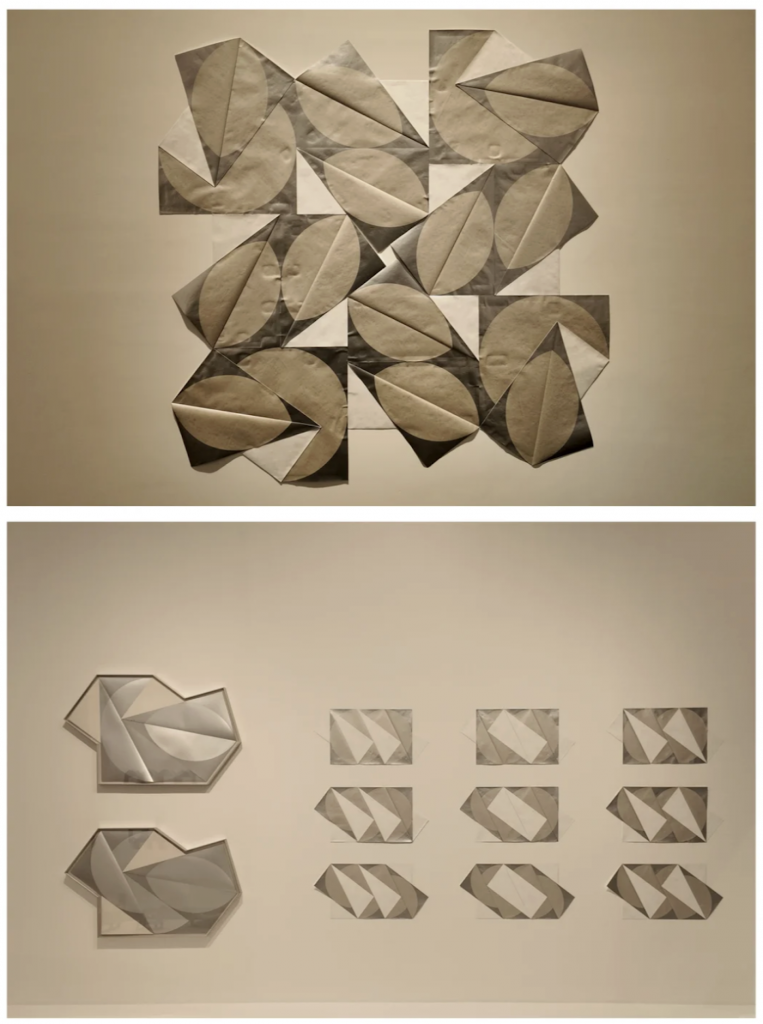
Liao Fei’s paper-based works frame folding not as an expressive gesture, but also as a method of formal deduction. In the ‘Partially Obscured Circles’ series (2024-2025), UCCA describes his process as a gradual derivation of folded and joined paper forms, producing a spatial contradiction between curve and straight line. The exhibition text further identifies a broader shift in his practice: from direct intervention in the material world to an internal investigation of geometric form and logical relations (UCCA, 2025). The perspective is particularly relevant to my project, which supports a more systematic approach to medium experimentation. Rather than treating paper simply as an image present, his practice suggests that it can function as a rule-based structure through which form is tested, unfolded, repeated, and transformed. His methodology encourages me to treat folding as a disciplined process of spatial and formal permutation. And each variation contributes to a broader material logic rather than being merely a visual effect.
1 Method
Edwards, H. (2013) ‘Folding’. IGNANT, 30 July. Available at: https://www.ignant.com/2013/07/30/folding/ (Accessed: 24 April 2026).
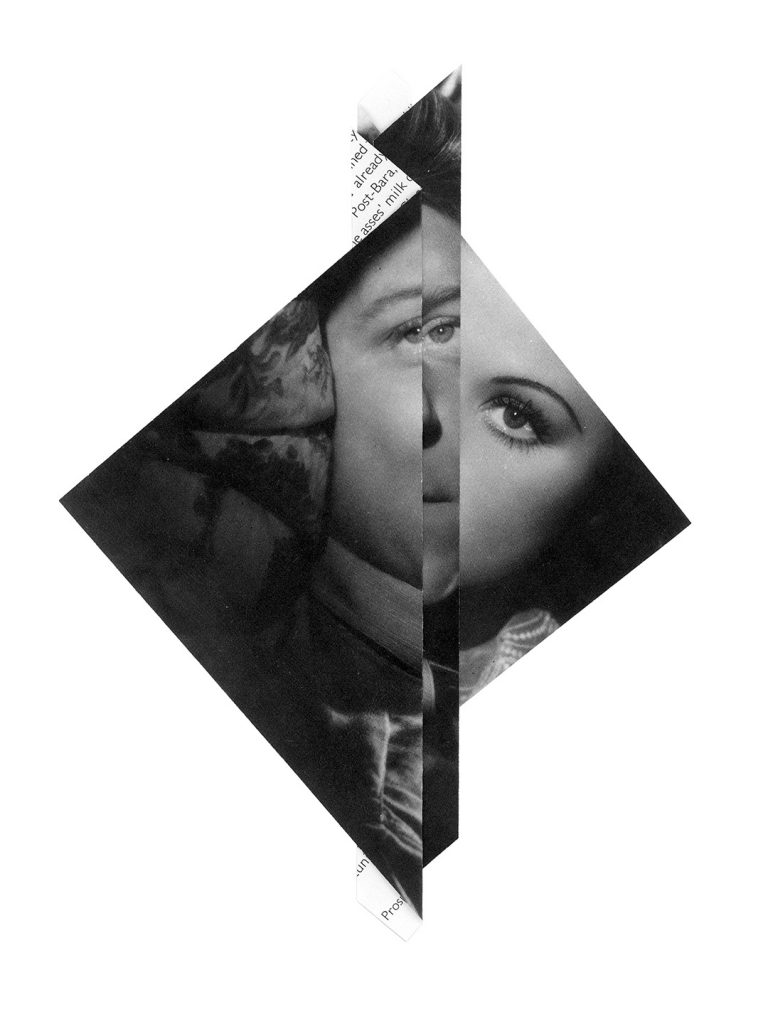
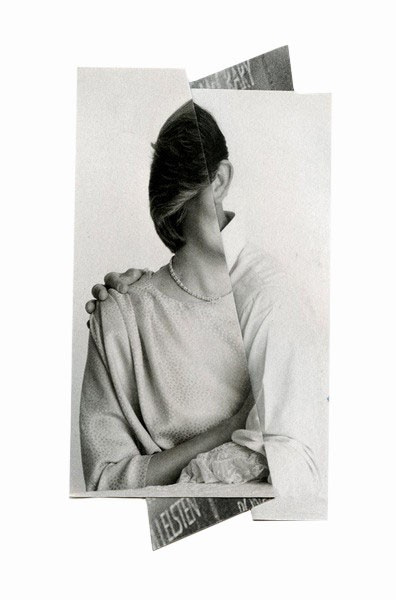
Eli Craven’s Screen Lovers is valuable to my further practice since it frames folding as a way of producing meaning through concealment and subtraction rather than through adding new content. The IGNANT article explains that his folds hide focal information and redirect attention towards secondary gesture, movement, and form (Edwards, 2013). This directly supports my experiments with folding as a material intervention into the image. It helped me clarify that folding does not simply distort an image, it redistributes visibility, suppresses certain cues, and changes what becomes legible first. In this sense, folding becomes a method for reorganising attention and generating altered meaning through physical manipulation.
Statement
This project explores how images organise their own conditions of viewing through folding, unfolding, and rescanning. It began with a digital snippet generated from the provisional outcomes of my previous iterative project. I initially examined, using digital software, how techniques including cutting, stretching, repetition, and degradation could alter its originally fixed presence and disrupt its stability.
Subsequently, I expanded and reframed the investigation through a series of paper-based experiments, employing two previously produced images and two folding methods to test how viewing conditions allow an image to be revealed in stages rather than displayed all at once. Its authority is continually challenged, and its meaning is repeatedly reinterpreted.
By scanning and documenting the processes and states of folding, unfolding, refolding, and pre-folding, I investigated how visibility is distributed across time and space. I also analysed how the boundaries of an image are redefined through physical transformation, and how interpretation changes when an image is encountered partially, sequentially, and repeatedly.
Therefore, this project is concerned not only with the content contained within the image itself, but also with how its structure, material condition, and the process of revelation directly influence its display. Additionally, it considers how viewing becomes a delayed, physical, and organised act of unfolding.
Leave a Reply