I selected p2–5 of Hito Steyerl’s In Defense of the Poor Image as the text for my cataloguing experiment. Through analysing the visual capitalism behind low-resolution images in the networked era, the author reveals their neglected significance — as a form of cultural life that bears witness to the politics of copying, migration, appropriation, resistance, and sharing (Steyerl, 2012). Referring to Lisa Gitelman’s definition of metadata as “data about the conditions of knowledge production” (Gitelman, 2013, p. 2), I aim to use this perspective to make the hidden relationships within the text more visible. At the same time, I draw on my own experience from the library return-shelf project, in which I catalogued ten books from a curatorial perspective, to examine the text’s structure through a similar lens.
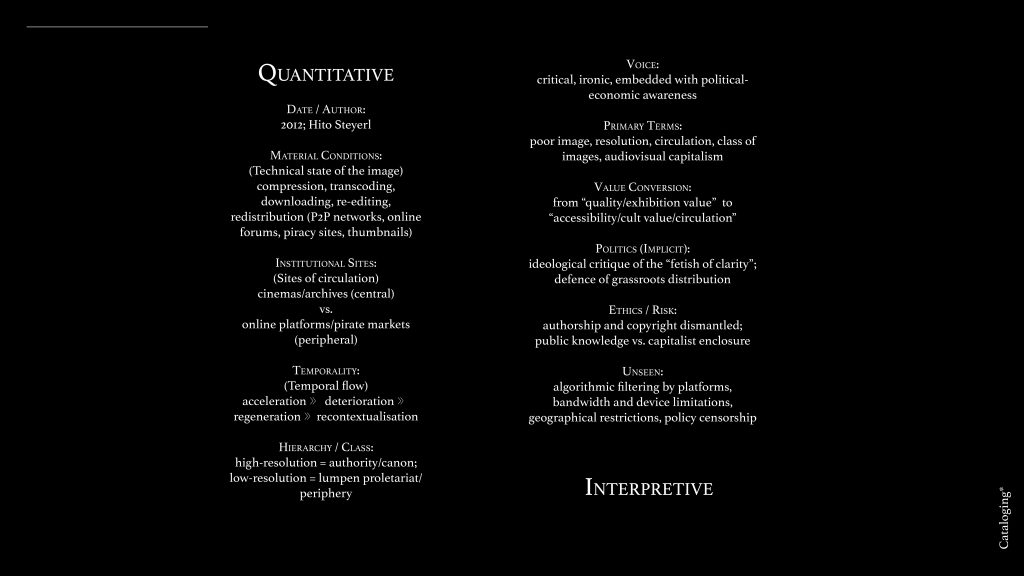
In my designed catalogue, the quantitative layer directly derives from the descriptive patterns of the text. Steyerl defines the poor image as “a copy in motion.” When the author lists actions such as compressing, uploading, and reformatting, these naturally form a technical process that can be recorded as metadata. The contrast between cinemas and archives versus online images establishes an institutional geography, while the opposition between high and low resolution reveals a quantifiable social hierarchy (Steyerl, 2012, pp. 2–3). By treating these as data, the essay’s rhetoric becomes measurable as infrastructure rather than taste. These fields translate her argument into a structural map.
The interpretive layer comes from the author’s tone and implicit politics. The poor image “transforms quality into accessibility, exhibition value into cult value” (Steyerl, 2012, p. 2). Steyerl ironically describes the poor image as the “Wretched of the Screen,” and critiques “visual capitalism,” showing that language itself participates in ideological production. The Unseen field originates from what she does not explicitly state — the invisible mechanisms of bandwidth, algorithms, and policy, which determine what images can be viewed and circulated.
Through this exercise, cataloguing becomes a way of reading that shifts my focus from content to relational structures. It also inspired reflection in my library return-shelf project: I began to view ten random books as “poor images” circulating within the readers’ gaze and movement. Steyerl’s method made me realise that the meaning of each book lies not only in its content but also in its social life of being viewed, borrowed, and positioned. Therefore, my five-dimensional gaze classification is built upon this metadata-based thinking, transforming reading behaviour itself into an observable and recontextualisable structure.
Reference
Gitelman, L. (2013) Raw Data is an Oxymoron. Cambridge, MA: The MIT Press.
Steyerl, H. (2012) ‘In Defense of the Poor Image’.
Leave a Reply